

Life as we know it is unimaginable without electricity. We’d be unable to light our homes, workplaces, leisure facilities, and streets and we’d be unable to use most of the equipment and technology we use in our everyday lives, imagine a world without a mobile phone or computer, unimaginable right?
A Little Background
Since the beginning of the industrialisation in the 19th century, coal has had a significant impact on the world’s energy supply. Coal remains one of the leading energy sources among all non-renewable resources worldwide. The use of hard coal (Anthracite – the most important type of coal), has even increased in recent years (1), which we’ll look at a bit further down. Coal is currently the most abundant source of electricity worldwide.
However, other important energy sources, including nuclear and renewable energy, mean coal has declined in favour of those, partly due to concerns about the impact of carbon dioxide and other emissions on the climate and the pathway to zero emissions. (2)
What is Coal Used For?
Besides electricity and heating, as we’ve mentioned above, coal has many other important uses in our lives, so many of which you’d be completely unaware that they used coal and coal by-products. Some of the most important and common uses include steel production, cement production which is an important commodity for building wind turbines, activated carbon used in filters for water and air purification systems, carbon fibers and foams for aeroplanes and vehicles, medicines, tars, synthetic petroleum-based fuels and silicon metal which is used to make lubricants. (2)
Coal’s Role in Renewable Energy
Wind and solar power are seen as cleaner energy and the energy of the future, green transition. However, these renewable energy sources, require coal for their manufacturing. Wind turbine manufacturing requires steel and cement which as we know coal is used for. And Solar Photovoltaics (PV) don’t require as much steel, but they do require silicon and coal is used in the production of solar-grade silicon. Therefore, we can see that coal plays a vital role in renewable energy sources.(3)
Despite its environmental challenges, coal plays a crucial role in supporting renewable energy sources by ensuring grid stability and a continuous power supply, which is vital for preventing power outages.
It would be wise to say that to be successful in the world’s transition to clean energy, we need to be considering all fuels and all technologies and not choosing one over the other. As we can see from the above information, coal can complement renewable energy sources.

Coal as an Affordable Energy Source
Many many millions live without access to electricity across the developing world. For this reason, coal use in some countries, especially in the developing world, is increasing, and other forms of energy, such as those mentioned above, are not readily available, and would most likely be highly unaffordable.
Coal-fired power plants provide affordable, reliable, and constant power that is available on demand to meet the energy consumption needs of modern-day living, therefore coal is still essential to alleviating worldwide energy poverty.
Given the expanding population growth around the world, which therefore drives the demand for increased electricity and infrastructure, especially in developing countries, it looks highly likely that coal will continue to be a key resource to sustain this. (2)
Coal’s Future
As we can establish from the information above, coal is very much still a key resource in the advancement of the global community but we know this comes with huge climate concerns.
It is essential that the industry, government, and public work together to develop commercially viable technologies to enable zero emissions in a carbon-constrained world. Support and funding for the development of commercially viable alternative coal products and technologies to extract rare earth minerals from coal will be essential. Coal’s future also hinges on the continued development of its industrial uses. (2)
Global Coal Production
The global production volume of coal has been steadily rising in recent years, according to Statista. In 2020 the global production volume was 158.7 exajoules, which increased to nearly 168 exajoules in 2021 and increased again in 2022 amounting to approximately 174.6 exajoules.
China is by far the leading hard coal producer worldwide. According to Statista, they were responsible for over 3.77 billion metric tons of hard coal produced, followed by India (778), Indonesia (554), the U.S (481) and Australia (433) in million metric tons. (4)
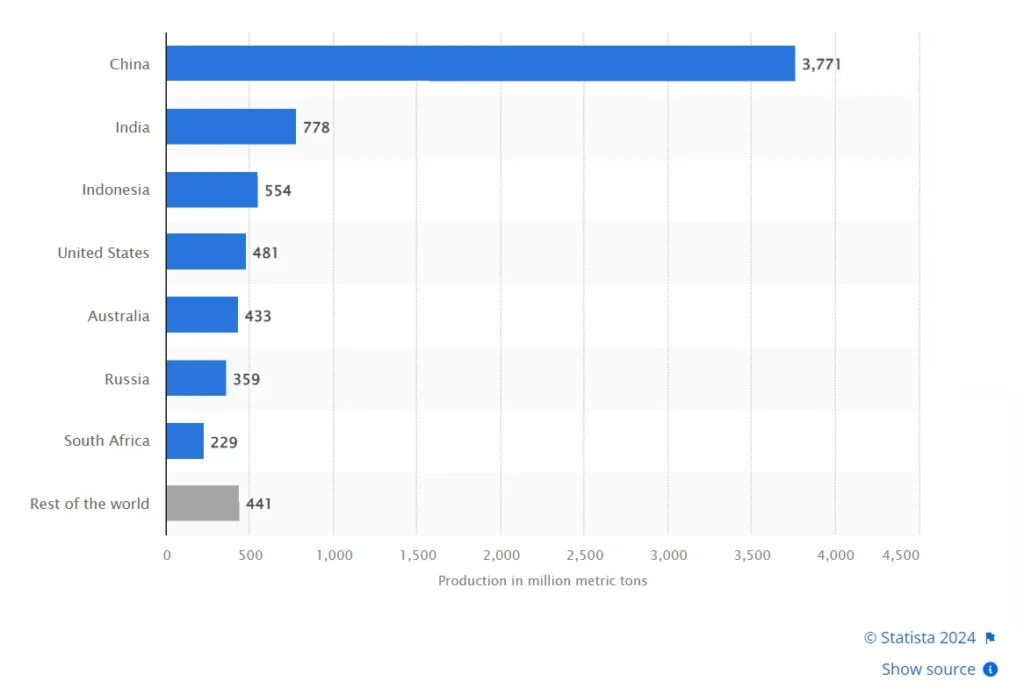
Although China has the largest hard coal production output, the U.S. holds the greatest reserves.
Conclusion
So as we can see from all of the information gathered here, coal is one of the leading energy sources among all non-renewable resources worldwide today. It has many uses including steel and cement production, which in turn are used for some of our renewable energy sources including wind and solar power. Coal does pose environmental challenges but before we are able to phase out the use of coal, we need some major advances in technologies to enable zero emissions.
For further information on coal mining, check out some of our podcast episodes below:
🔹Coals’ Role in the Energy Transition: https://bit.ly/4aLF0Ft
🔸Plans for Colonial Coal International in The Current Coal Market: https://bit.ly/44gvGXu
🔹The World Still Needs Coal to Keep the Lights: https://bit.ly/44a8fiR
Don’t forget to Subscribe to our Newsletter for further insights into the mining industry, direct to your mailbox.
Sources:
- https://www.statista.com/topics/1051/coal/#topicOverview
- https://www.smenet.org/What-We-Do/Technical-Briefings/Coal-s-Importance-in-the-US-and-Global-Energy-Supp
- https://www.futurecoal.org/futurecoal-spotlight-series-coal-renewables/
- https://www.statista.com/statistics/264775/top-10-countries-based-on-hard-coal-production/