
In today’s mining industry, an ongoing debate is taking shape: Is a formal degree truly necessary for a range of roles, or is significant, hands-on experience just as, if not more, valuable? This conversation touches on a deeper question about how the sector will effectively shape and tap into its future talent pool.
The debate is not about roles that legally require a degree—those are non-negotiable. But in many other areas of mining, companies often insist on degree requirements for roles where they aren’t strictly necessary. This practice can inadvertently restrict opportunities for highly experienced individuals whose skills have been honed over years of field work. Should mining companies reconsider these hiring criteria, particularly in an environment where talent shortages are common?
The Current State of Hiring in Mining
Mining, like many other industries, has been grappling with talent shortages, demographic changes, and the increasing need for diverse skill sets. Against this backdrop, companies tend to fall back on established hiring norms—such as prioritising candidates with degrees—as a way to manage the perceived risks associated with recruitment. However, what these norms can miss is the wealth of knowledge and skill that comes from practical experience.
For roles like mine construction, commissioning, process plant operations, or maintenance management, professionals have argued that their capabilities are often the product of years on the ground, managing teams and responding to evolving challenges in dynamic environments. One comment we received illustrated this well: “Process improvement, the ability to coach and mentor talent—these things can’t be taught at university. They come from experience.” This insight brings to light an important aspect of mining operations—the crucial, intangible skills that are not always imparted in academic programmes.
Degrees vs Experience: A Deeper Comparison
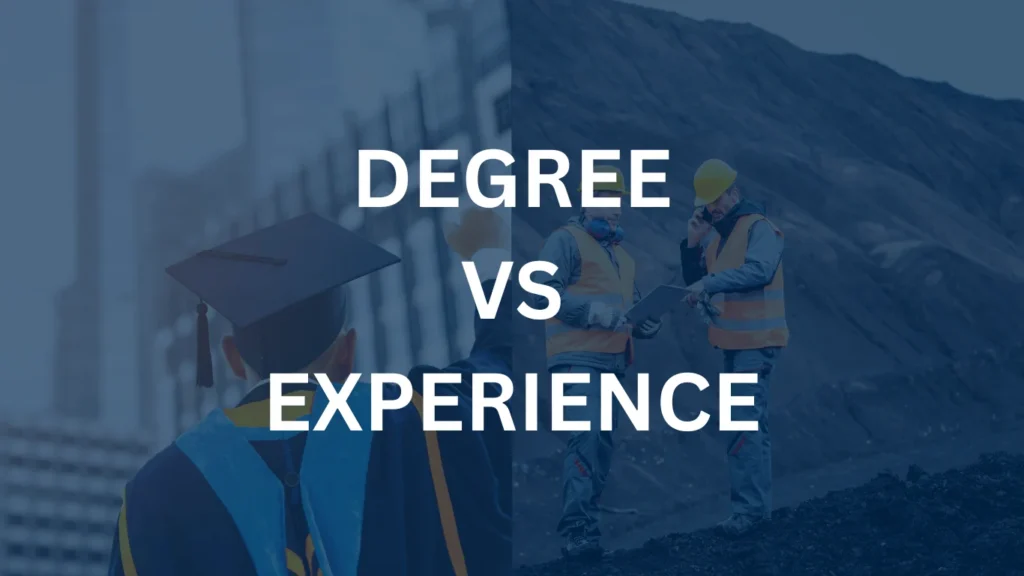
Let’s compare the advantages of each side. A degree undeniably provides foundational knowledge, structured learning, and access to theories and technologies that might otherwise be inaccessible. University-trained geologists, mine engineers, and metallurgists are well-equipped with the conceptual and technical tools needed for various specialised tasks. For companies, hiring someone with a formal degree offers some assurance of a baseline level of training and exposure.
However, in roles where field adaptability, operational problem-solving, and interpersonal leadership are key, experience tends to speak louder. These roles often benefit from candidates who have worked across various projects, learning through direct exposure to different mines, commodities, and logistical challenges. Experienced candidates have encountered and resolved real-world problems—whether that involves managing safety incidents, optimising machinery use, or improving team productivity during times of peak demand.
A workshop or maintenance management role is a perfect example. For a workshop manager, practical skills like understanding how machinery operates, the typical challenges on site, and familiarity with the kinds of equipment failures likely to occur are crucial. An apprentice-trained professional, who has literally worked “on the tools,” can often offer more immediate value than someone with theoretical knowledge gained in a classroom. The capacity to troubleshoot in real-time and apply creative solutions comes directly from years of accumulated, hands-on experience.
Industry Trends and the Bias Towards Degrees
It is important to acknowledge that the bias towards academic qualifications is not unique to mining. Across many industries, degrees are viewed as an essential marker of capability and commitment. But it’s worth questioning whether this trend best serves the future needs of mining. In a sector so heavily dependent on practical expertise, companies that remain rigid about degree requirements could risk missing out on a significant pool of talent.
The industry is evolving quickly, with advancements in automation, remote operations, and environmental sustainability leading the way. The adoption of new technologies will demand diverse skill sets, and it’s here that blending academic knowledge with experienced, adaptable personnel can create an optimal team structure. Hiring practices that undervalue experience in favour of formal qualifications may limit the capability to adapt to such changes effectively.
Several mining professionals we’ve interacted with have highlighted that experience often comes with the added ability to transfer knowledge. Workers who have been through the cycles of boom and bust can pass on invaluable lessons to newer entrants. This kind of mentorship is crucial for maintaining continuity and stability in an industry known for its volatility. However, the insistence on degrees as a prerequisite might prevent these veteran professionals from moving into the leadership roles where their impact could be the most pronounced.
A Call for Balance: Hiring with an Open Mind

For companies striving to future-proof their talent pool, a balanced approach to hiring is crucial. While academic qualifications bring undeniable value, they shouldn’t automatically outweigh real-world experience in every situation. Instead, the focus should be on clearly defining the skills required for each role and maintaining flexibility in how these skills are demonstrated. For some roles, a degree may be essential; for others, years of demonstrated expertise in the field could be even more valuable.
What can mining companies do to ensure they are not closing the door on potential talent?
- Define Job Requirements Flexibly: Distinguish between roles where degrees are necessary and those where practical skills or certifications are more relevant. Mining companies should communicate these differences clearly in job postings, making room for a wider range of candidates.
- Evaluate Experience Holistically: When reviewing applications, give weight to diverse types of experience. Hands-on skills gained through apprenticeship or field operations can be as critical as theoretical knowledge.
- Embrace Competency-Based Hiring: Companies should consider using competency-based interviews that focus on real-life problem-solving and examples of past work, rather than just educational credentials.
- Build Pathways for Skilled Workers: Consider offering internal training and development programs that help experienced but non-degreed employees gain further qualifications or move into higher-level positions. These programs can help experienced professionals continue to grow within the company.
Conclusion
As the mining industry looks to its future, it must adapt to shifting demographics, emerging technologies, and evolving operational demands. This means not only finding talent but also recognising that capability can be built in more than one way—whether that’s through academic study or a career’s worth of experience. By valuing practical expertise alongside formal qualifications, mining companies can build a workforce that is versatile, resilient, and ready for the challenges ahead.
In conclusion, the key to successful hiring in the mining industry isn’t to disregard degrees or diminish their value. Instead, it is about opening doors to those whose path has been shaped by the rugged terrain of real-life experience, allowing the industry to draw from a wider, richer talent pool and thrive in the face of new challenges. After all, experience is often the best teacher, and the mining industry could benefit greatly from acknowledging the lessons learned outside of the classroom.
At Mining International, we understand the value of both formal education and hands-on experience. Our tailored executive search approach ensures we identify candidates who bring the right combination of skills, be it academic qualifications or practical expertise, to meet our clients’ specific needs. By partnering with us, mining companies can ensure they aren’t missing out on exceptional talent—whether that talent comes from a university or from years in the field. We’re here to help you build a workforce equipped for both today’s challenges and the future of mining.
For further articles and insights on the latest trends in the mining industry, be sure to sign up for our quarterly newsletter and explore our additional resources.